Walk Hard begins outside, at nightfall. A dolly zoom stretches a plain storage building as the moon climbs behind it into the stars. Inside is a single room — not a stage, not a soundstage, but a storage unit, real and unremarkable, with blue trim and white walls. A guitarist stands inside it and plays. There is no other performer and no other location. Everything else in the film will change around this one fixed point.
At first the room holds still. Then it begins to rot: cracked walls, an old wooden file cabinet, insects crawling across the plaster. The camera pushes through a hole in the wall, past mold and bare two-by-fours, to find the player on the other side. The performance never breaks. Only the world around it keeps turning, stage by stage, deeper and darker each time.
Then the wall explodes. The player becomes a shadow, still moving in time with the music, as bugs stream into the breach. The decay becomes an infestation: a spider, massive cockroaches, a rat crossing a long corridor. Abandoned mirrors start showing the player where no camera stands.
The corridor becomes a threshold. The player sits on a box surrounded by fire, a mirror behind him showing his back. Then he rises one last time on the stairwell, just before the drop.
The pivotal moment arrives on a single descending guitar line. As the note falls, so does the player, lowered on a chained platform into a lava-lit underworld on the same downward gesture the music is making. Sound and image fall together, on the same beat.
Down there, the platform hangs over a volcano that is really hell. It is a stage that turns out to be a trap, in hard rock's long Faustian tradition of the bargain and the fall. One step too many, and the player falls into the fire. The film ends in flames. The performance is never once interrupted — only surrounded, transformed, and finally consumed.

A Study in Directed Generative Compositing
Walk Hard is a hybrid practical–generative music film and the origin point of the Production 2.0 series. It was made before any methodology existed: one performer, one storage unit, and Adobe Firefly brought in as an experiment to dress the room. A live guitar performance, shot vertically at 24 fps, anchors the film throughout. The world around it — the decay, the infestation, the descent, the fire — was generated and composited on the Final Cut Pro timeline with magnetic mask. Nothing was built in After Effects.
Production methods documented in the white paper include:
Directed generative compositing — generation applied to the environment, with the practical performance kept as the plate wherever it exists
Aesthetic-anchor prompting — the storage unit's real blue trim and white walls prompted into every generated environment, so generated and practical clips intercut without a visible seam
Impossible camera positions — the camera placed inside and through walls, where no physical camera could go
Reflection compositing — a green screen generated inside a moving mirror, tracked with magnetic mask, and the live performance composited into the reflection
The virtual camera — the model directed to generate a rear view of an existing front shot, creating coverage that was never filmed
Kinetic Descent Match — the performer's descent into hell timed to a descending guitar line
Editorial-first assembly — every generated clip treated as raw material and corrected before entering the cut, with painted shadows to ground composited figures and slow zooms to animate static captures
None of these were planned. Each surfaced during the edit, and together they became the seeds of the methods later volumes formalized. The film's climactic fall is itself a happy accident: a discarded take of the artist stepping toward the camera to stop recording, recognized in the edit and repurposed as the step into the fire.
Walk Hard is presented as an origin study, an honest account of a first attempt. It is the question every later volume in this series builds on: how far can one real location be expanded before the camera itself becomes optional?
Read the full technical white paper on Zenodo.
Official Repository Record: https://doi.org/10.5281/zenodo.22930706
Official Repository Record: https://doi.org/10.5281/zenodo.22930706
Read the technical white paper →
Published as open research on Zenodo.
Published as open research on Zenodo.
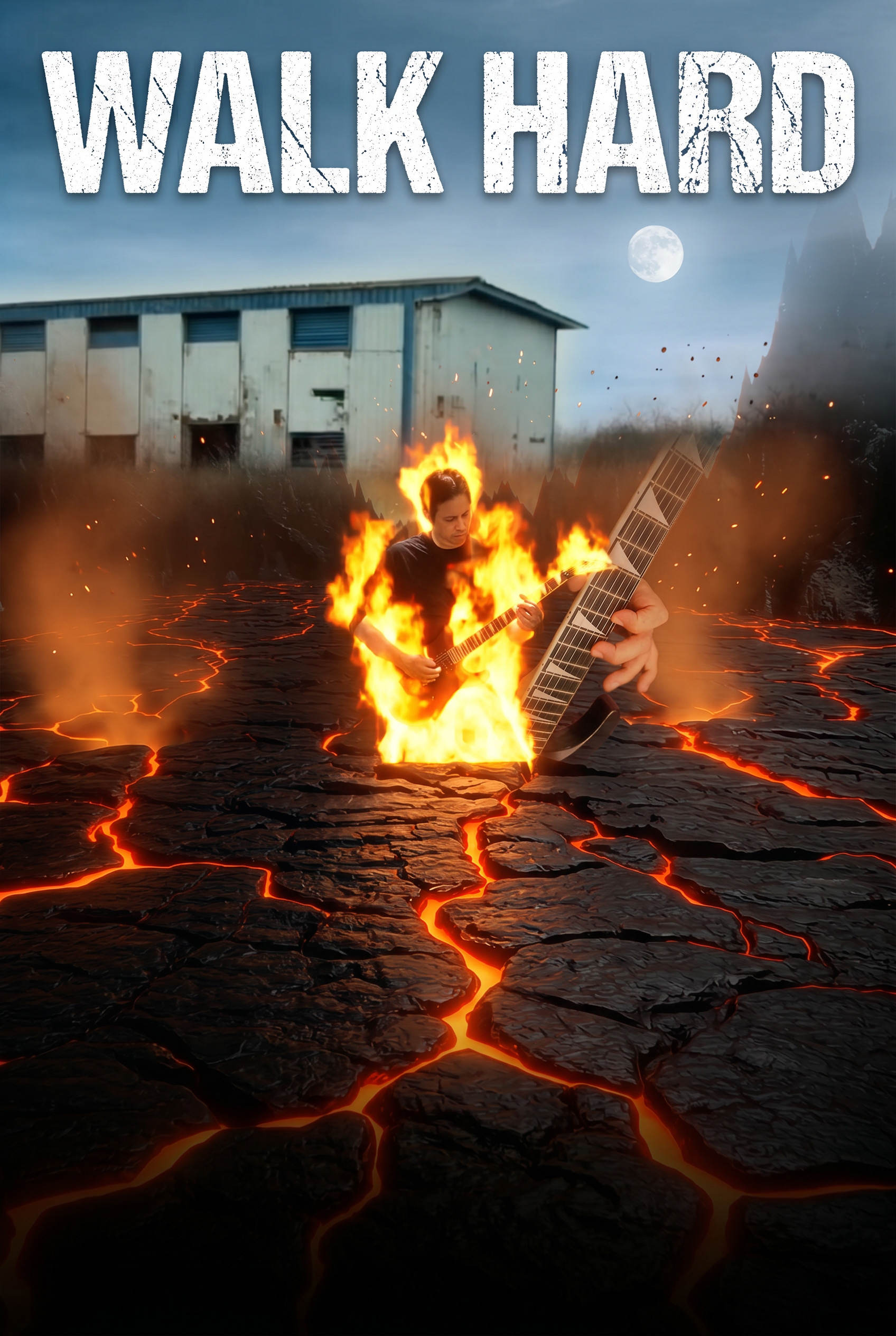
WALK HARD HYBRID-PRACTICAL GENERATIVE MUSIC VIDEO

CONNECT WITH MONTEREY PHOTOGRAPHY STUDIOS
Monterey is a generative film studio exploring new forms of cinematic storytelling. For inquiries or collaboration, you may reach the studio here.
Thank you!